Thursday, December 30, 2010
Ethics
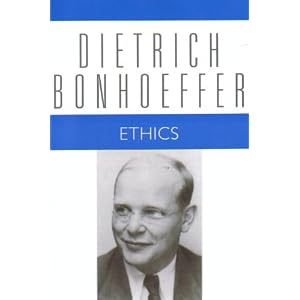
by Dietrich Bonhoeffer
Reviewed by Paul
What a challenge from start to finish. Bonhoeffer immediately turns the whole idea of ethics on its head by refusing to use the expected format in his treatise. Most Christian authors would first make a review of the recent works and issues in question. Then apply a Christian “stamp” to the issue, and say why this question should be answered this way or that way. But this true Christ-follower does not limit God to stamps, but like Jesus shows the question itself to need reforming. But, again like Jesus, he does not thereby forsake the questioner, but addresses the person with a challenge and a claim. He starts with the answer: Jesus Christ. And throughout he does not stray from this answer. Whether it is the heart, the mind, the family, or the country, the person of God made flesh in Jesus is central.
The author writes this his Magnus Opus in the midst of Nazi Germany. Under great pressure, culminating in his arrest with the book unfinished. After some time in prison, Bonhoeffer was executed by the Third Reich near the end of the war. This after purposely deciding to stay in Germany, speaking and writing, leading the break-off branch of pastors and congregations who would not bind themselves to the Nazis.
We cannot know how the book would look if it were published in the “proper” way, but it seems to me that it was very nearly complete. The publishers did a fine job in putting it together with extensive notes (a few too may notes for me, thanks, could have saved paper), and it seems well-translated. It seems the last chapter is the least finished, they note that parts were found on his table the day he was arrested. I think that this last chapter could actually be seen as his own notes and rough drafts.
One challenge of course of this book is the depth of intellect and spirituality that is in it. It is not a quick read by any means. I felt like I could spend a week contemplating each of the first few pages and not be wasting time. His arguments get quite complex and sometimes difficult to follow, especially regarding the “ultimate” and “penultimate.” But I found it worth pushing through, even though there is much I missed. Do not be afraid to take a sip though you may not be able to finish the whole draught.

Subscribe to:
Post Comments (Atom)
Sounds good! Would you read it again, or is it one of those one time read books?
ReplyDeleteI would say it is tough to get through but I might read it again in 10 years. In the mean time it is highly-underlined reference.
ReplyDelete